Insurance Affordability, Availability Demand Collaboration, Innovation
By Lewis Nibbelin, Contributing Writer, Triple-I

Insurance industry executives and thought leaders gathered yesterday for Triple-I’s Joint Industry Forum (JIF) in Chicago to discuss the trends, economics, geopolitics, and policy influencing the market today, as well as ways to navigate these complexities while focusing on making their products affordable and available for consumers.

Triple-I CEO Sean Kevelighan in his opening remarks, noted that effective risk management depends on collaboration across stakeholder groups, as interconnected perils “present a community problem, not just an industry problem.”
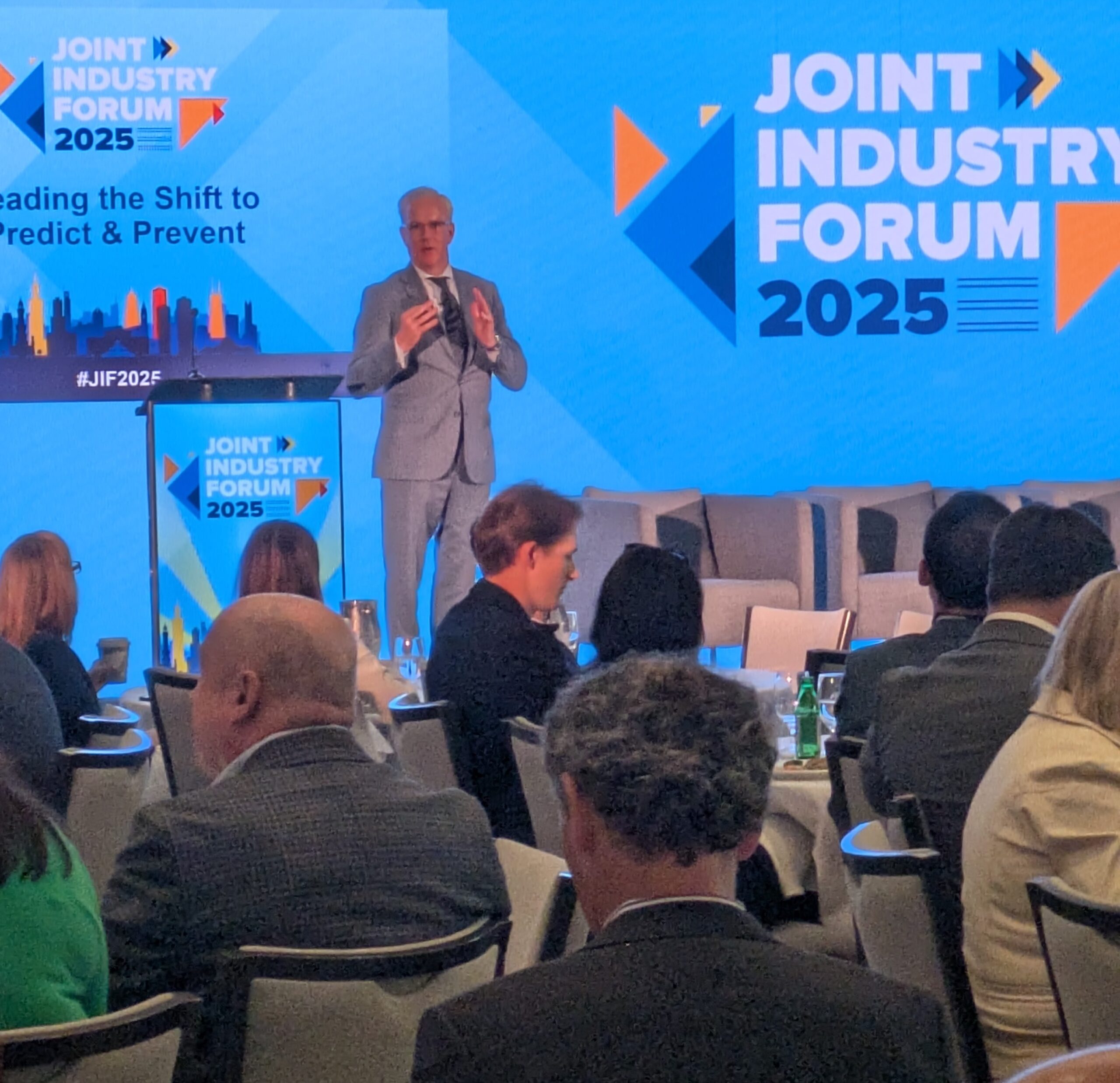
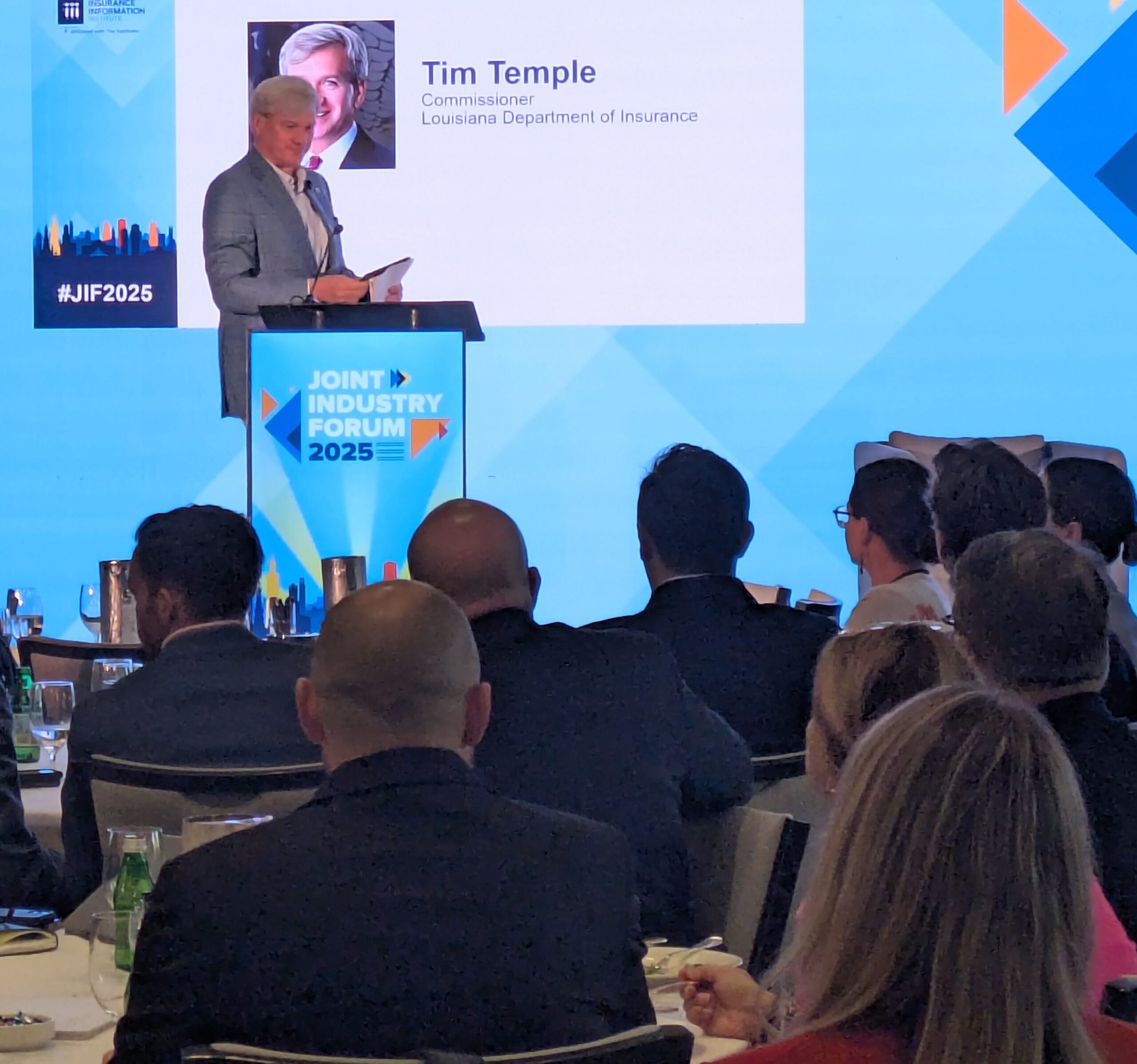
JIF keynote speaker Louisiana Insurance Commissioner Tim Temple said facilitating community resilience planning is a top priority for the National Association of Insurance Commissioners (NAIC). The NAIC’s 2025 initiative  – “Securing Tomorrow: Advancing State-Based Regulation” – aims to improve disaster mitigation and recovery by consolidating “the collective expertise of experienced state regulators from across the country, who can share real-time insights and proven strategies,” Temple said.

Among the initiative’s goals is aggregating more data from insurers to better understand challenges to affordability and availability on state levels, which the NAIC can then translate into actionable policy proposals. Such data calls, Temple said, help regulators, legislators, and policyholders focus on improving the cost drivers of insurance rates.
Louisiana has consistently been among the least affordable states for homeowners and auto insurance, according to the Insurance Research Council (IRC), in part because of its reputation for being plaintiff-friendly in civil litigation. Significant tort legislation has been approved in the state, but resistance to reform remains a challenge.

Getting to the roots of high premiums

 After a recent data call in his home state, Temple told the JIF audience, “For the first time in Louisiana, we’re not talking about only premiums. We’re talking about why premiums are where they are.”

A critical lack of transparency surrounding cost drivers persists, however. Temple criticized the National Flood Insurance Program’s Risk Rating 2.0 reforms for not publicly disclosing more information “for individuals and communities to identify and address factors driving up their premiums,” such as “whether increased rates take into account levee systems, pump stations, and other things designed to help mitigate against floods.”

Conversely, government programs like Strengthen Alabama Homes – and the numerous programs it inspired, including in Louisiana – have demonstrated success in communicating the benefits of resilience investments for consumers and policymakers.

“We’re seeing major positive results after just a few short years,” Temple said, noting that, since early 2024, over 5,000 homeowners not chosen for Louisiana’s grant program still decided to invest in the same hazard mitigation, as they may still qualify for the corresponding state-mandated insurance discounts.

“As natural disasters become more frequent and severe, state regulators will continue to drive forward common-sense policies that protect consumers and ensure that insurance remains available and reliable for at-risk communities,” Temple concluded. Developing the database required for such policies is a necessary first step.

Keep an eye on the Triple-I Blog for further JIF coverage.

Learn More

Significant Tort Reform Advances in Louisiana

Louisiana Senator Seeks Resumption of Resilience Investment Program

Louisiana Reforms: Progress, But More Is Needed to Stem Legal System Abuse

Louisiana Is Least Affordable State for Personal Auto Coverage Across the South and U.S.

Who’s Financing Legal System Abuse? Louisianans Need to Know

Study Touts Payoffs From Alabama Wind Resilience Program

Outdated Building Codes Exacerbate Climate Risk

Resilience Investments Paid Off in Florida During Hurricane Milton

How regulatory changes are reshaping motor insurance in India

India’s motor insurance sector is undergoing significant transformation driven by IRDAI reforms, technological advancements, and evolving consumer preferences. These changes include standardized policies, flexible ‘pay-as-you-go’ options, and long-term coverage mandates. Telematics, data analytics, and specialized policies for electric and autonomous vehicles are further shaping a more inclusive and tech-friendly insurance landscape.

Personal Auto 2024 Underwriting Results Best Since Pandemic

By William Nibbelin, Senior Research Actuary, Triple-I

The U.S. personal auto insurance industry saw a significant turnaround in 2024, achieving its best underwriting result since the pandemic began, according to Triple-I’s latest Issues Brief.  

In fact, with a net combined ratio of 95.3, personal auto insurance has outperformed the broader property and casualty (P/C) insurance industry in terms of underwriting profitability for 10 out of the last 20 years. A combined ratio under 100 indicates an underwriting profit. One above 100 indicates a loss.

This positive shift comes after a period in which personal auto premiums experienced fluctuations. While the overall P/C industry outpaced personal auto in premium growth from 2018 to 2022, personal auto saw a strong rebound in 2023 and 2024, with double-digit premium growth rates of 14.4 percent and 12.8 percent, respectively. This surge in premiums follows a notable decline in 2020, the first since 2009, largely due to reduced driving during the initial phase of the COVID-19 pandemic. Since then, vehicle miles driven have returned to pre-pandemic levels.

A major factor influencing auto insurance premiums has been the significant rise in replacement costs for vehicles and parts after the pandemic. Insurers adjusted rates in response to these increased costs. The changes in consumer prices for new and used vehicles, as well as parts and repairs, have shown a strong correlation with average insurance rate adjustments over the past decade:

  • New Vehicles: 88 percent correlation;
  • Motor Vehicle Parts & Equipment: 74 percent correlation;
  • Used Vehicles: 79 percent correlation; and
  • Motor Vehicle Maintenance & Repair: 78 percent correlation.

Looking at losses, the direct incurred loss ratio for personal auto improved considerably by 21.7 points from late 2022 to the end of 2024. However, this improvement wasn’t uniform across all types of claims. Auto physical damage claims saw more improvement than auto liability claims, creating the largest disparity between the two in over a decade of 15.7 points.

Loss trends in personal auto are shaped by how often claims occur (frequency) and the average cost of each claim (severity). For personal auto liability, while the number of claims has stayed below pre-pandemic levels, the average cost per claim has continued to rise year after year with a cumulative increase from 2019 to 2024 of 54.2 points.

One of the significant challenges contributing to the increasing severity in personal auto liability is what’s known as legal system abuse. This includes a rise in lawsuits, larger jury awards, and more attorney involvement in claims. This phenomenon, intertwined with broader inflation, has driven up auto liability losses and related expenses by a range of $76.3 billion to $81.3 billion from 2014 to 2023 according to the latest Triple-I | Casualty Actuarial Society study.

Another important factor impacting the auto insurance market is the state regulatory environment. A recent report by the Insurance Research Council on Rate Regulation in Personal Auto Insurance indicated that the process for insurers to get rate changes approved has become more complex across the country between 2010 and 2023. This has led to longer approval times and a higher incidence of insurers receiving less than their requested rate increases. These trends can ultimately affect the availability of competitive auto insurance policies for consumers.

Learn More:

Even With Recent Rises, Auto Insurance Is More Affordable Than During Most of Century to Date

New IRC Report: Personal Auto Insurance State Regulation Systems

U.S. Consumers See Link Between Attorney Involvement in Claims and Higher Auto Insurance Costs: New IRC Report